
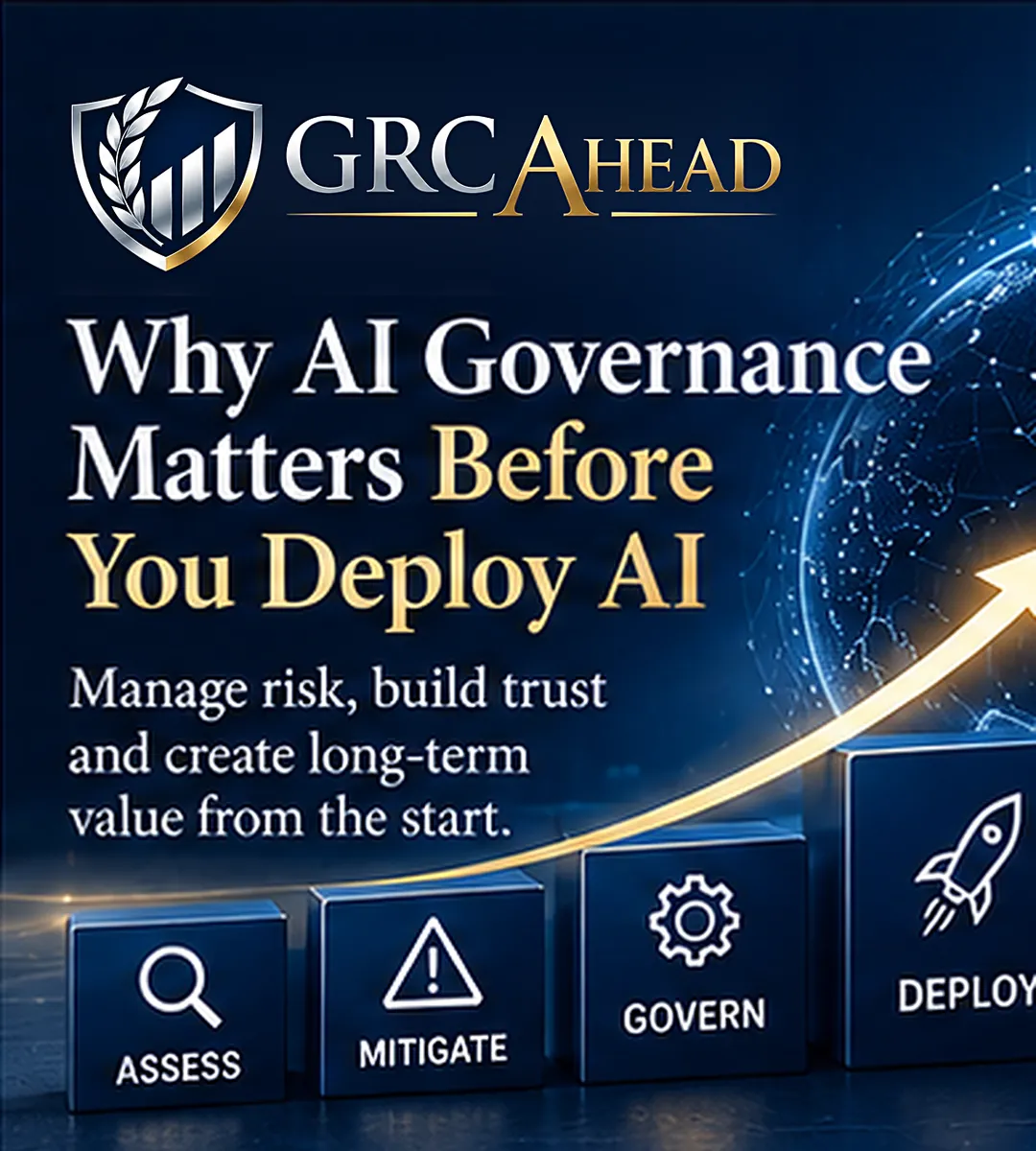
Artificial Intelligence is no longer a future consideration. Across industries, organisations are actively exploring AI-powered tools to improve efficiency, automate processes and support decision-making. While the potential benefits are significant, many organisations are moving faster with AI adoption than they are with AI governance.
This creates a critical question:
Should organisations focus on AI deployment first, or governance first?
The answer is governance.
What is AI Governance?
AI governance refers to the policies, processes, control's and oversight mechanisms that help ensure Artificial Intelligence is used responsibility and effectively.
Good governance helps organisations understand:
- What AI systems are being used
- Who is accountable for AI-related decisions
- What risks exist
- How compliance requirements are met
- How AI systems are monitored and reviewed
Governance is not about preventing innovation. It is about enabling innovation safely and responsibly.
The Risks of Deploying AI Without Governance
Many organisations introduce AI tools without fully understanding the associated risks.
Common challenges include:
Lack of Visibility
Employees may already be using AI systems without formal approval. This can result in sensitive information being shared with external platforms without adequate controls.
Unclear Accountability
When issues arise, organisations often struggle to answer a simple question:
Who owns AI risk?
Without defined accountability, governance becomes fragmented and ineffective.
Regulatory Exposure
Regulatory expectations are evolving rapidly. Organisations should understand how emerging frameworks, including the EU AI ACT, may impact governance, risk management and compliance obligations.
Reputational Risk
AI-generated outputs can be inaccurate, biased or misleading.
Without appropriate oversight. organisations may face reputational damage and loss of stakeholder trust.
Governance Supports Adoption
A common misconception is that governance slows AI initiatives. In reality, strong governance provides the foundation needed to scale AI confidently. Organisations that establish governance early are better positioned to:
- Adopt AI safely
- Demonstrate accountability
- Manage risks effectively
- Build stakeholder confidence
- Respond to regulatory requirements
Governance should be viewed as an enabler rather than an obstacle.
Key Questions Every Organisation Should Ask
Before implementing AI solutions, organisations should consider:
- Do we know what AI tools are currently being used?
- Do we have an AI policy?
- Who owns AI governance?
- How are AI risks assessed?
- How will AI outputs be monitored?
- Are we prepared for emerging regulations?
- Can we demonstrate accountability if challenged by regulators, customers or stakeholders?
Final Thoughts
Artificial Intelligence offers enormous opportunities, but successful adoption requires more than technology. Organisations that invest in governance, accountability and oversight before deploying AI will be better prepared to realise the benefits while managing the associated risks.
The question is not whether organisations will use AI.
The real question is whether they are ready to govern it effectively.
- AI for small businesses
- AI Governance
- EU AI Act
- Responsible AI
- AI Governance Checklist
- AI Risk Management
- AI Governance Maturity
- AI Cyber Security
- AI Compliance
- AI Governance Framework
- AI Risk Assessment
- AI Governance Policy
- AI Consulting
More insights

23 October 2026 · 6 min read
Is Your Business Using AI Without Proper Governance? 5 Risks US Companies Can't Ignore
Is your business using AI without proper oversight? Discover five AI governance risks facing US companies and how to address them.
Read article
8 October 2026 · 2 min read
What Are the Five Principles of AI Governance?
The five principles of AI Governance help organisations manage AI risk, support responsible AI and build trust in Artificial Intelligence systems. Learn how accountability, transparency, fairness, security and human oversight form the foundation of effective AI Governance Frameworks, AI compliance programmes and AI risk management practices as organisations prepare for evolving regulations and standards such as ISO 42001.
Read article
8 October 2026 · 3 min read
Can You Give Me an Example of AI Governance?
Can You Give Me an Example of AI Governance? Explore real-world AI governance examples, AI risk assessments, responsible AI controls, AI compliance frameworks and practical governance programmes used by organisations.
Read article