
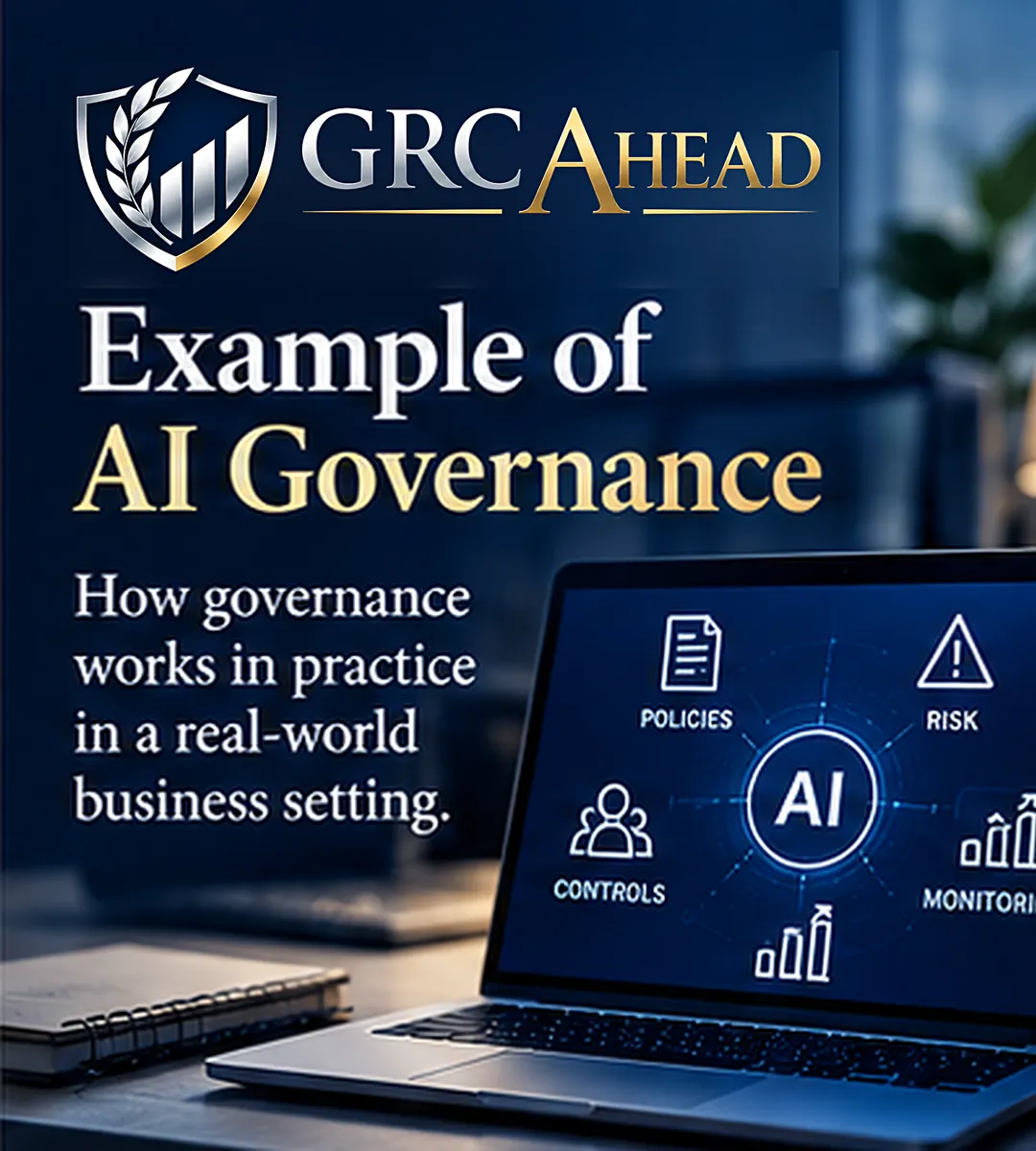
One of the most common questions organisations ask when beginning their AI journey is:
"Can you give me an example of AI governance?"
AI Governance sounds like a complex concept, but in reality it is simply the framework of policies, controls, oversight and risk management processes used to ensure Artificial Intelligence is deployed responsibly and safely.
The easiest way to understand AI Governance is through real-world examples.
Example 1: Employee Use of ChatGPT in the Workplace
Many organisations now allow employees to use ChatGPT and other Generative AI tools to draft emails, create reports, summarise information and improve productivity.
Without an AI Governance Framework, employees might:
- Upload confidential information
- Share customer data
- Rely on inaccurate AI-generated content
- Create compliance and security risks
With AI Governance in place, organisations can:
✅ Implement an AI Acceptable Use Policy
✅ Define what information can and cannot be shared with AI tools
✅ Require human review of AI-generated content
✅ Monitor AI usage across the organisation
✅ Conduct regular AI Risk Assessments
This is one of the most practical examples of AI Governance in action.
Example 2: AI Recruitment and Hiring Systems
Many organisations use Artificial Intelligence to screen applications, rank candidates and improve recruitment processes.
Without proper governance, AI systems could:
- Introduce recruitment bias
- Produce unfair outcomes
- Lack transparency
- Create legal and compliance concerns
A strong AI Governance Programme would include:
✅ Human oversight of recruitment decisions
✅ AI Risk Management processes
✅ Regular testing for fairness and bias
✅ Monitoring and reporting controls
✅ Documented policies and procedures
This helps ensure responsible AI use throughout the hiring process.
Example 3: AI Customer Service Chatbots
AI-powered chatbots are increasingly used to answer customer queries and provide support.
Without governance:
- Customers may receive incorrect information
- AI responses may become inconsistent
- Security risks may increase
- Accountability may be unclear
An AI Governance Framework should include:
✅ Performance monitoring
✅ Human escalation routes
✅ Security controls
✅ Incident management procedures
✅ Ongoing oversight and review
The goal is to maintain customer trust while benefiting from automation.
Example 4: Enterprise AI Governance Programmes
Large organisations often establish formal AI Governance Programmes that support AI innovation while managing risk.
These programmes commonly include:
AI Policies
Clear rules for responsible AI usage.
AI Registers
Inventories of AI systems used across the organisation.
AI Risk Assessments
Processes used to identify and evaluate AI-related risks.
Governance Committees
Groups responsible for oversight, accountability and decision-making.
Executive Reporting
Regular updates on AI usage, risks and compliance activities.
These components help organisations demonstrate accountability and trustworthiness.
What Do All AI Governance Examples Have in Common?
Regardless of how AI is used, successful AI Governance Frameworks typically include:
✅ Defined accountability
✅ Human oversight
✅ AI Risk Management
✅ Responsible AI principles
✅ Policies and controls
✅ Performance monitoring
✅ Compliance management
✅ Ongoing review and improvement
The purpose of AI Governance is not to restrict innovation. It is to ensure AI is implemented responsibly and sustainably.
How Does ISO 42001 Support AI Governance?
As AI adoption grows, many organisations are exploring ISO 42001, the international standard for Artificial Intelligence Management Systems.
ISO 42001 supports AI Governance by helping organisations establish:
- Governance structures
- Risk management processes
- Accountability mechanisms
- Performance monitoring
- Continuous improvement practices
For many organisations, ISO 42001 forms the foundation of a mature AI Governance Framework.
Final Thoughts
A simple example of AI Governance is an organisation implementing policies, oversight and risk management controls for employee use of ChatGPT. A broader example is a formal AI Governance Programme that includes governance frameworks, AI risk assessments, responsible AI controls, compliance monitoring and executive oversight. As Artificial Intelligence becomes increasingly embedded in organisations, effective AI Governance will be critical for managing risk, maintaining trust and supporting responsible innovation.
Frequently Asked Question
Can you give me an example of AI Governance?
Yes. A common example of AI Governance is an organisation creating policies and controls for employee use of ChatGPT, conducting AI Risk Assessments, monitoring AI usage and ensuring human oversight of AI-generated outputs.
What Do You Think?
How is your organisation using AI today?
Have you implemented an AI Governance Framework, AI Risk Assessment process or Responsible AI controls?
Share your thoughts in the comments below.
Need help establishing an AI Governance Framework? Enquire About an AI Governance Readiness Assessment with GRC Ahead and discover how prepared your organisation is for responsible AI adoption.
More insights

23 October 2026 · 6 min read
Is Your Business Using AI Without Proper Governance? 5 Risks US Companies Can't Ignore
Is your business using AI without proper oversight? Discover five AI governance risks facing US companies and how to address them.
Read article
8 October 2026 · 2 min read
What Are the Five Principles of AI Governance?
The five principles of AI Governance help organisations manage AI risk, support responsible AI and build trust in Artificial Intelligence systems. Learn how accountability, transparency, fairness, security and human oversight form the foundation of effective AI Governance Frameworks, AI compliance programmes and AI risk management practices as organisations prepare for evolving regulations and standards such as ISO 42001.
Read article
8 October 2026 · 3 min read
What Is AI Governance in Simple Terms?
What Is AI Governance in Simple Terms? Discover how AI governance frameworks help organisations manage AI risk, ensure AI compliance, support responsible AI, meet ISO 42001 requirements and build trusted AI governance programmes.
Read article