
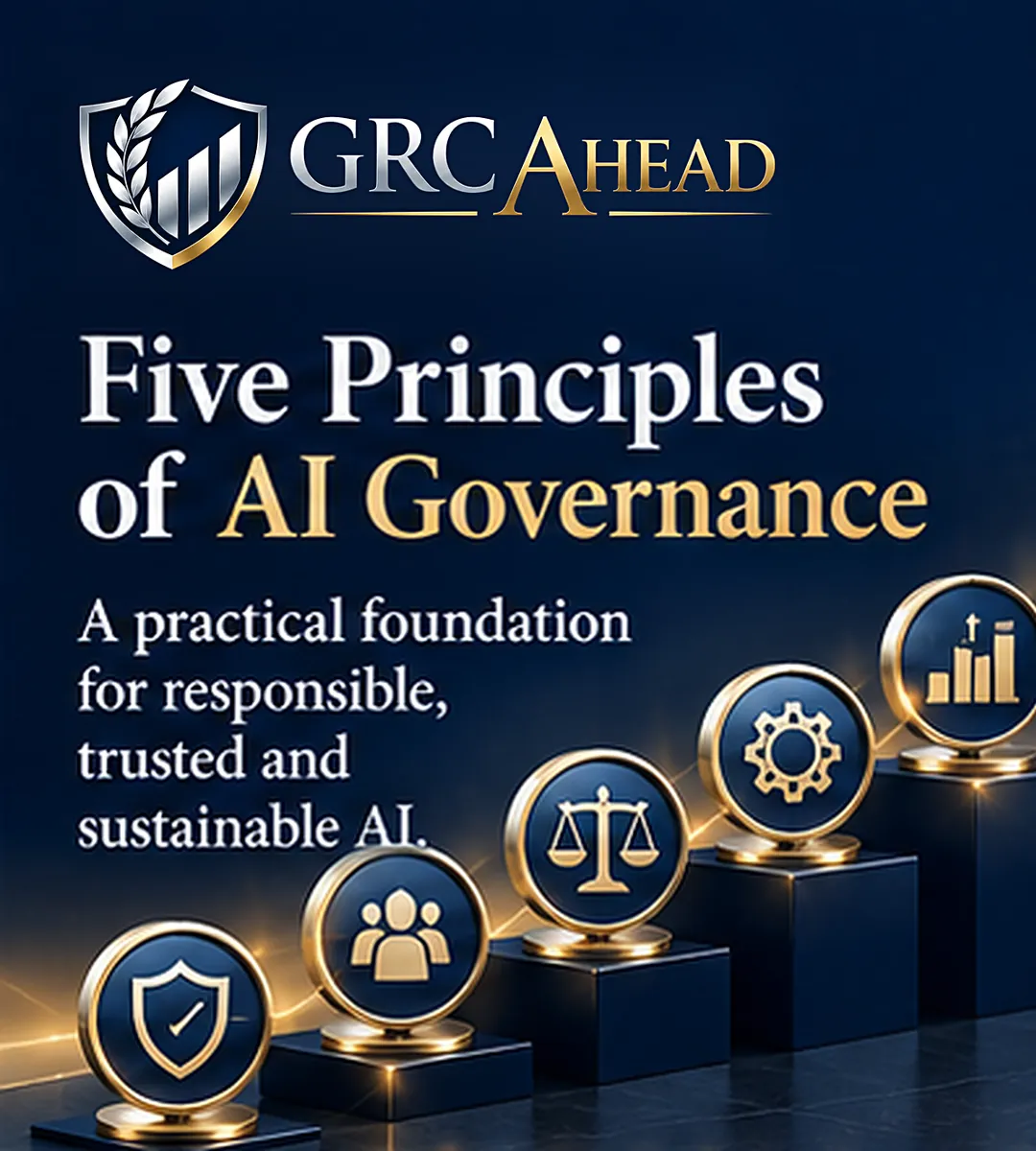
As organisations adopt Artificial Intelligence at an increasing rate, effective governance has become essential. But what does good AI Governance actually look like? While frameworks vary between organisations, most successful AI Governance Programmes are built around five core principles that help ensure AI is used responsibly, safely and transparently.
1. Accountability
One of the most important principles of AI Governance is accountability. Organisations must clearly define who is responsible for the development, deployment and oversight of AI systems. Without accountability, it becomes difficult to manage risks, address issues and demonstrate compliance.
Questions organisations should ask include:
- Who owns the AI system?
- Who approves AI use cases?
- Who monitors AI performance?
- Who manages AI risks?
Accountability creates ownership and trust throughout the organisation.
2. Transparency
AI systems should not operate as "black boxes."
Organisations need to understand:
- How AI systems work
- What data they use
- How decisions are generated
- What limitations exist
Transparency helps users, customers and regulators understand how AI is being applied.
It also supports trust and informed decision-making.
3. Fairness
AI systems should be designed and monitored to minimise bias and promote fair outcomes.
Without proper governance, AI may unintentionally produce discriminatory or inconsistent results.
Organisations should regularly assess AI systems for:
- Bias
- Accuracy
- Consistency
- Reliability
Fairness is particularly important for AI applications used in recruitment, lending, healthcare and customer-facing services.
4. Security and Privacy
AI systems often process large amounts of information, making security and privacy critical considerations.
Effective AI Governance Frameworks include controls to protect:
- Sensitive information
- Customer data
- Intellectual property
- Organisational assets
Strong security controls help reduce operational, cybersecurity and compliance risks.
5. Human Oversight
AI should support human decision-making, not replace it entirely.
Human oversight ensures:
- AI outputs are reviewed
- Critical decisions remain under human control
- Risks are identified early
- Errors can be corrected
As AI capabilities expand, maintaining meaningful human oversight becomes increasingly important.
How Do These Principles Support AI Governance?
Together, these principles form the foundation of a strong AI Governance Framework.
They help organisations:
✅ Manage AI Risk
✅ Demonstrate AI Compliance
✅ Improve trust in AI systems
✅ Support Responsible AI practices
✅ Prepare for ISO 42001
✅ Respond to evolving regulations such as the EU AI Act
By embedding these principles into governance programmes, organisations can innovate with confidence while maintaining appropriate control.
Final Thoughts
The five principles of AI Governance are:
- Accountability
- Transparency
- Fairness
- Security and Privacy
- Human Oversight
These principles help organisations build trusted AI Governance Frameworks that support innovation while managing risk and ensuring responsible AI adoption. As AI becomes increasingly embedded in business operations, organisations that prioritise these principles will be better positioned to navigate regulatory requirements, maintain trust and realise the benefits of Artificial Intelligence.
What Do You Think?
Which of these principles do you believe is the most important?
Does your organisation currently have an AI Governance Framework in place?
Share your thoughts in the comments below.
More insights

23 October 2026 · 6 min read
Is Your Business Using AI Without Proper Governance? 5 Risks US Companies Can't Ignore
Is your business using AI without proper oversight? Discover five AI governance risks facing US companies and how to address them.
Read article
8 October 2026 · 3 min read
Can You Give Me an Example of AI Governance?
Can You Give Me an Example of AI Governance? Explore real-world AI governance examples, AI risk assessments, responsible AI controls, AI compliance frameworks and practical governance programmes used by organisations.
Read article
8 October 2026 · 3 min read
What Is AI Governance in Simple Terms?
What Is AI Governance in Simple Terms? Discover how AI governance frameworks help organisations manage AI risk, ensure AI compliance, support responsible AI, meet ISO 42001 requirements and build trusted AI governance programmes.
Read article