
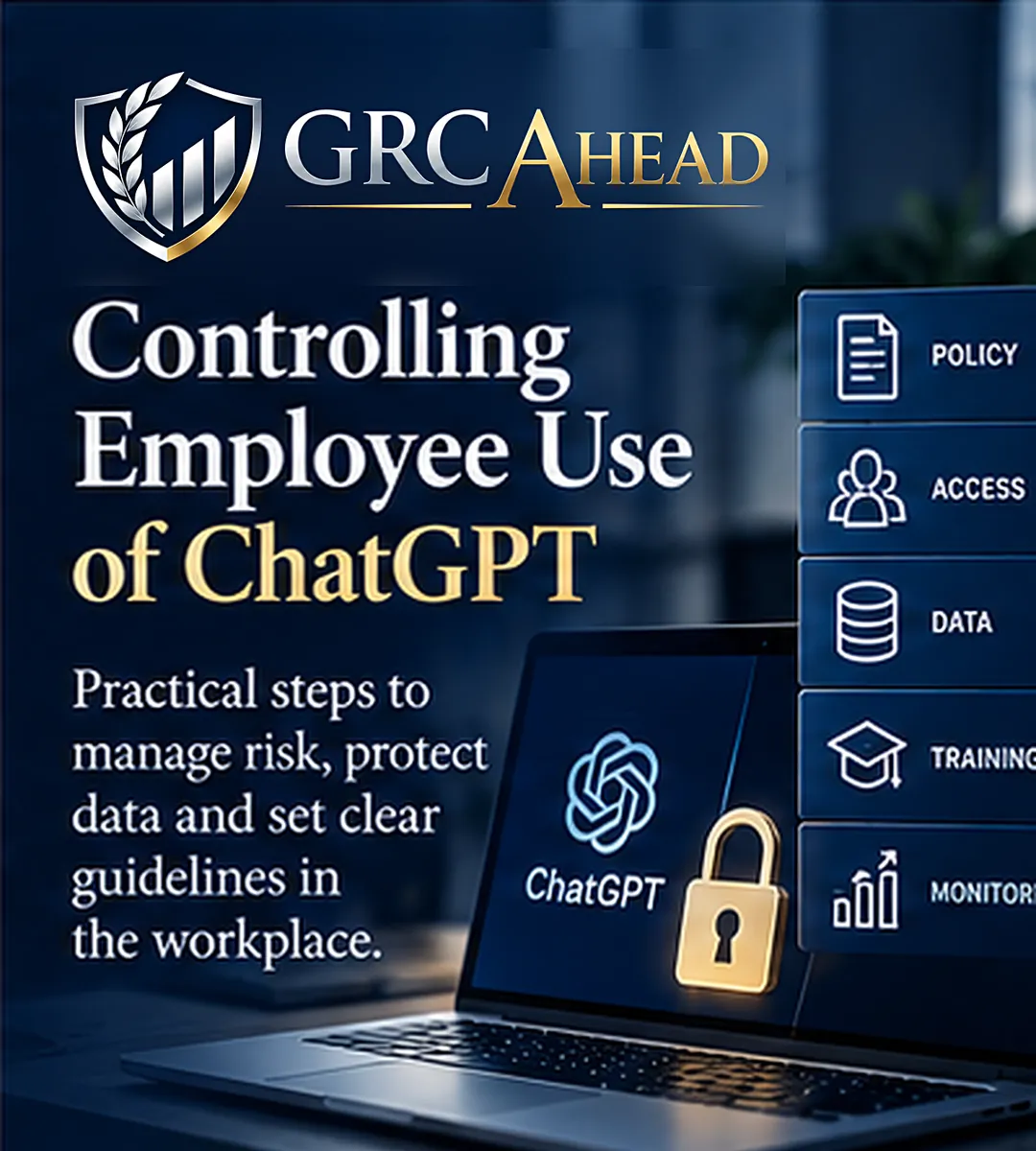
Employees Are Already Using AI: The Challenge of Controlling ChatGPT at Scale
Many organisations are searching for the best way to control employee use of ChatGPT at scale while still allowing teams to benefit from AI tools such as ChatGPT, Microsoft Copilot, Gemini and Claude. By the time leadership becomes aware, AI is often being used across HR, marketing, customer service, software development and operations. The challenge is no longer whether employees are using AI. The challenge is how to control employee use of ChatGPT at scale without slowing innovation, productivity or business growth.
Why Employee ChatGPT Use Creates Governance Risks
Without governance controls, employees may:
- Upload confidential information
- Share customer data
- Use unapproved AI tools
- Create inaccurate outputs
- Make business decisions based on hallucinations
- Violate regulatory requirements
- Introduce copyright and intellectual property risks
The result is not necessarily a major incident tomorrow.
The real risk is unmanaged business exposure that grows over time.
Common Mistakes Organisations Make
Banning ChatGPT Completely
Many organisations initially react by prohibiting AI tools.
The reality is that employees often continue using AI anyway, creating Shadow AI risks that are harder to detect and monitor.
Allowing Unrestricted AI Use
The opposite approach is just as dangerous.
Without policies, training and oversight, organisations have little visibility into how AI is being used.
Focusing Only on Technology
Technology controls alone are not enough.
AI governance must include people, processes, accountability and risk management.
How to Control Employee Use of ChatGPT at Scale
Step 1: Understand Where AI Is Being Used
Create an inventory of:
- AI tools
- Business use cases
- Data being processed
- Teams using AI
You cannot govern what you cannot see.
Step 2: Create an AI Usage Policy
Employees need clear guidance on:
- What information can be entered into AI tools
- Approved use cases
- Restricted activities
- Data handling requirements
An AI Usage Policy should be the foundation of any AI governance programme.
Step 3: Establish Approved AI Tools
Rather than allowing employees to use any AI tool they choose, organisations should define approved solutions such as:
This reduces risk while still enabling innovation.
Step 4: Prevent Confidential Data Disclosure
Implement controls to protect:
- Personal data
- Customer information
- Financial data
- Intellectual property
- Commercially sensitive information
Data loss prevention, employee training and data classification are key controls.
Step 5: Monitor and Audit AI Usage
Organisations should regularly monitor:
- AI adoption
- Approved AI tools
- Emerging risks
- Compliance requirements
- Governance effectiveness
Monitoring is essential for maintaining long-term control.
AI Governance Checklist for ChatGPT
Before scaling employee AI usage, organisations should confirm they have:
✅ AI Governance Policy
✅ AI Usage Policy
✅ Approved AI Tool Inventory
✅ AI Risk Assessment Process
✅ Employee Awareness Training
✅ Monitoring Controls
✅ Executive Oversight
✅ Regular Governance Reviews
What Good ChatGPT Governance Looks Like
Organisations that successfully govern AI typically have:
- An AI policy
- Defined AI roles and responsibilities
- AI risk assessments
- AI usage inventory
- Management oversight
- Employee awareness training
- Ongoing monitoring
The goal is not to stop innovation.
The goal is to enable safe, responsible and compliant AI adoption.
Final Thoughts
Employees are already using AI.
The biggest mistake organisations can make is ignoring the issue and hoping it goes away.
The best way to control employee use of ChatGPT at scale is through governance, approved tools, employee training, monitoring and executive oversight.
Organisations that establish these controls early can benefit from AI while reducing security, compliance and operational risks.
- AI for small businesses
- AI Governance
- EU AI Act
- Responsible AI
- AI Governance Checklist
- AI Risk Management
- AI Governance Maturity
- AI Cyber Security
- AI Compliance
- AI Governance Framework
- AI Risk Assessment
- AI Governance Policy
- AI Consulting
More insights

23 October 2026 · 6 min read
Is Your Business Using AI Without Proper Governance? 5 Risks US Companies Can't Ignore
Is your business using AI without proper oversight? Discover five AI governance risks facing US companies and how to address them.
Read article
8 October 2026 · 2 min read
What Are the Five Principles of AI Governance?
The five principles of AI Governance help organisations manage AI risk, support responsible AI and build trust in Artificial Intelligence systems. Learn how accountability, transparency, fairness, security and human oversight form the foundation of effective AI Governance Frameworks, AI compliance programmes and AI risk management practices as organisations prepare for evolving regulations and standards such as ISO 42001.
Read article
8 October 2026 · 3 min read
Can You Give Me an Example of AI Governance?
Can You Give Me an Example of AI Governance? Explore real-world AI governance examples, AI risk assessments, responsible AI controls, AI compliance frameworks and practical governance programmes used by organisations.
Read article