
AI Readiness for Business: 7 Essential Steps Before Adopting AI
GRC Ahead · · 3 min read
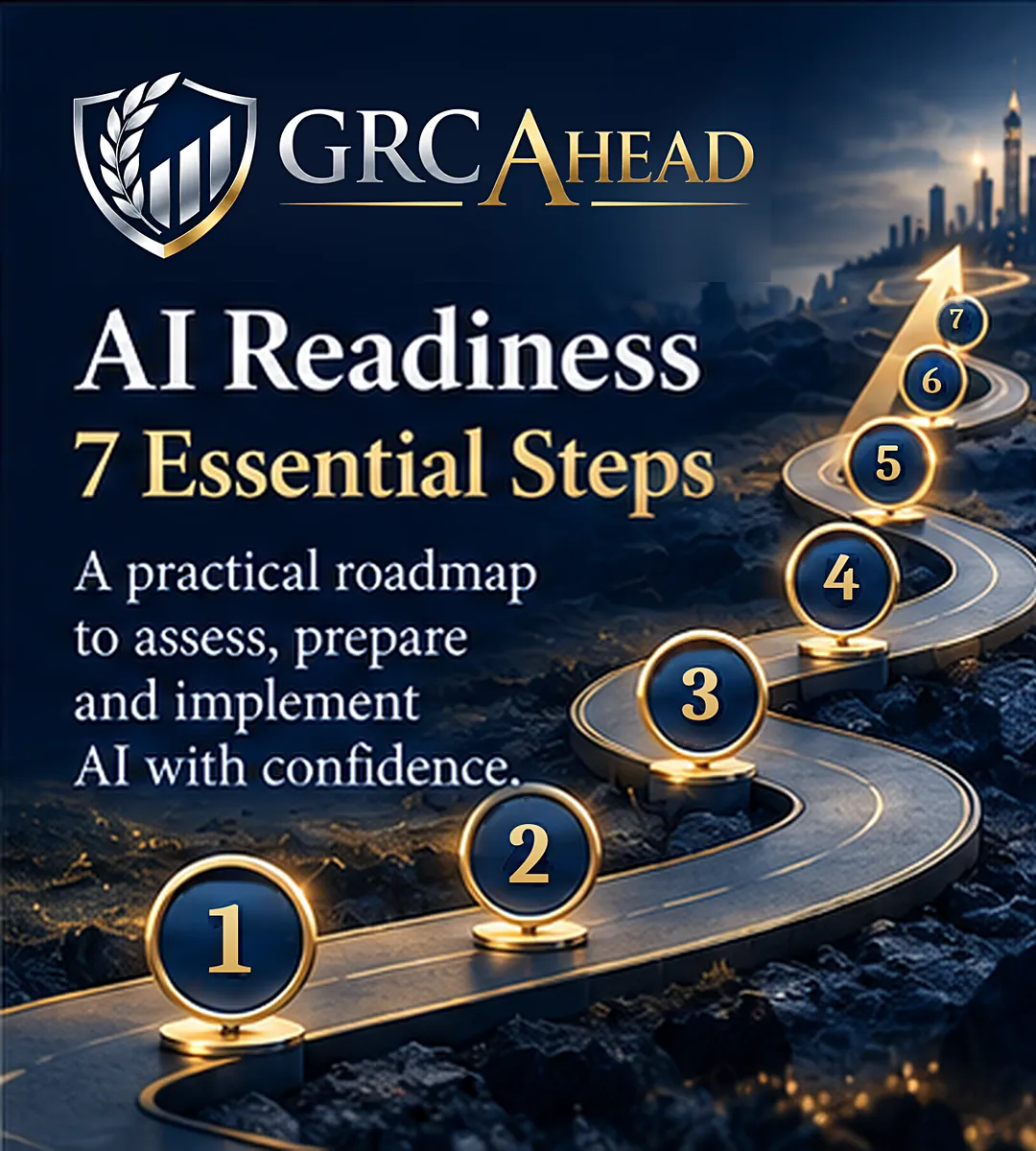
Artificial Intelligence is transforming the way businesses operate. From automating repetitive tasks to improving customer service and generating valuable business insights, AI offers significant opportunities for organisations of every size.
However, many business rush into AI adoption without proper preparation, creating unnecessary risks, wasted investment, and disappointing results. Before introducing AI into your organisation, it's important to build the right foundations. Here's how.
- Understand Why You Want AI.
One of the biggest mistakes organisations make is implementing AI simply because everyone else is.
Instead of starting with technology, start with business problems.
Ask yourself:
What processes are consuming too much time?
Where are employees performing repetitive manual tasks?
What customer frustrations could be improved?
What decisions would benefit from better insight?
Successful AI projects solve real business challenges rather than chasing trends.
- Review Your Data Quality.
AI is only as good as the data it receives.
Before implementing any AI solution, assess:
- Data accuracy
- Data completeness
- Data consistency
- Data ownership
- Data security
Poor-quality data can lead to inaccurate outputs, unreliable recommendations, and poor business decisions.
Many AI projects fail because organisations overlook this critical step.
- Strengthen Information Security
AI systems often process sensitive business information, employee data, customer records, or intellectual property.
Before adopting AI, ensure your organisations has:
- Information security policies
- Access controls
- Data classification standards
- Secure authentication
- Incident response processes
Protecting data must remain a priority throughout your AI journey.
- Create an AI Usage Policy
Employees are already experimenting with tools such as ChatGPT, Co-pilot, Gemini, and other generative AI platforms.
Without clear guidance, staff may intentionally expose confidential information.
An AI policy should cover:
- Approved AI tools
- Prohibited activities
- Data handling requirements
- Human review expectations
- Security responsibilities
Clear policies help employees use AI safely and responsibly.
- Identify Potential Risks
Every AI Implementation introduces risks that should be considered before deployment.
These may include:
- Privacy concerns
- Inaccurate outputs
- Bias in decision-making
- Regulatory compliance issues
- Intellectual property concerns
- Third-party supplier risks
Performing a simple risk assessment early can prevent major issues later.
- Train Your Employees
AI should not replace critical thinking.
Employees need training on:
- How AI works
- Its limitations
- Verifying AI-generated content
- Protecting sensitive information
- Using approved tools.
Organisations that invest in AL awarness typically achieve better adoption rates and safer outcomes.
- Establish Governance and Oversight
As AI usage grows, organisations need accountability.
Consider assigning responsibilities for:
- AI approvals
- Risk assessments
- Policy Management
- Vendor reviews
- Ongoing monitoring
Even small organisations benefit from basic governance to ensure AI remains aligned with business objectives.
The Businesses That Benefit Most from AI
The organisations seeing the greatest value from AI are not necessarily the ones using the most advanced tools.
They are businesses that:
- Have clear objectives
- Understand their data
- Manage risks appropriately
- Train their people
- Implement governance from day one
AI can deliver incredible benefits, but preparation is what turns portential into results.
Final Thoughts
AI is no longer a technology reserved for large enterprises. Businesses of all sizes can benefit from AI, but successful adoption starts long before the first tool is implemented.
By focusing on strategy, data, security, governance, and employee education, your organisation can confidently embrace AI while reducing risk and maximising value.
Ready to introduce AI into your business? Start by Assessing your current readiness before investing in technology. The strongest AI programmes are built on strong foundations, not rushed deployments.
- AI for small businesses
- AI Governance
- EU AI Act
- Responsible AI
- AI Governance Checklist
- AI Risk Management
- AI Governance Maturity
- AI Cyber Security
- AI Compliance
- AI Governance Framework
- AI Risk Assessment
- AI Governance Policy
- AI Consulting
More insights

23 October 2026 · 6 min read
Is Your Business Using AI Without Proper Governance? 5 Risks US Companies Can't Ignore
Is your business using AI without proper oversight? Discover five AI governance risks facing US companies and how to address them.
Read article
8 October 2026 · 2 min read
What Are the Five Principles of AI Governance?
The five principles of AI Governance help organisations manage AI risk, support responsible AI and build trust in Artificial Intelligence systems. Learn how accountability, transparency, fairness, security and human oversight form the foundation of effective AI Governance Frameworks, AI compliance programmes and AI risk management practices as organisations prepare for evolving regulations and standards such as ISO 42001.
Read article
8 October 2026 · 3 min read
Can You Give Me an Example of AI Governance?
Can You Give Me an Example of AI Governance? Explore real-world AI governance examples, AI risk assessments, responsible AI controls, AI compliance frameworks and practical governance programmes used by organisations.
Read article