
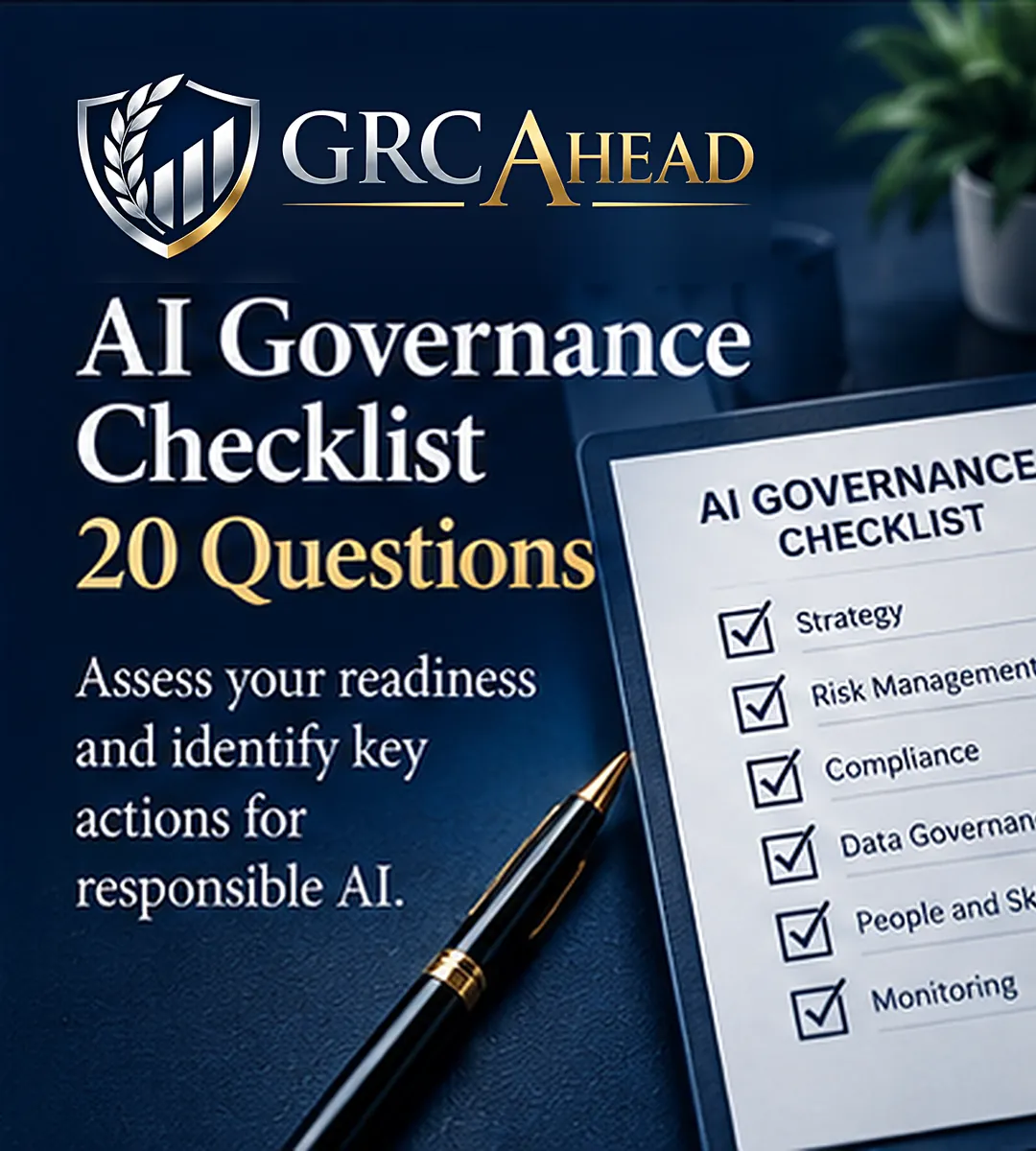
AI Governance Checklist: 20 Questions Every Organisation Should Answer in 2026
GRC Ahead · · 4 min read
Artificial Intelligence is rapidly transforming the way organisations operate. From Microsoft Co-pilot and ChatGPT to AI-powered analytics, automation, and decision-making tools, businesses are adopting AI faster than ever before.
However, many organisations are implementing AI without establishing the governance needed to manage risk, maintain compliance, and ensure responsible use.
As regulator's increase their focus on AI, organisations must be able to demonstrate accountability oversight, risk management, and transparency.
This AI Governance Checklist will help you asses your organisation's readiness and identify areas for improvement.
AI Governance Checklist
Answer each question with Yes, No, or Partially.
Governance & Oversight
- Do we have a documented AI Governance Policy ?
- Do we know every AI tool currently being used across the organisation ?
- Is there executive ownership and accountability for AI governance ?
- Do we have a defined process for approving new AI tools and use cases ?
- Do we review our AI governance program on a regular basis ?
AI Risk Management
- Do we perform AI risk assessments before introducing new AI solutions ?
- Are AI -related risks recorded within our risk register ?
- Have we identified any high-risk AI use cases within the organisation ?
- Are AI outputs reviewed before being used to support important business decisions ?
- Would our current AI controls withstand regulatory or auditor scrutiny ?
AI Compliance & Responsible AI
- Have we assessed our obligations under the EU AI Act ?
- Can we explain how AI-generated recommendations or decisions are produced ?
- Is human oversight built into critical AI-assisted activities ?
- Are AI systems monitored for bias,fairness and unintended outcomes ?
- Do we have a process for reporting and managing AI-related incidents ?
AI Security & Data Protection
- Do employees understand what information shoudl never be entered into public AI tools ?
- Are access controls in place for AI systems and platforms ?
- Have we assessed the security risks associated with AI solutions ?
Third-Party AI Risk
- Have we assessed the risks associated with AI vendors and suupliers ?
- Do you contracts contain appropriate AI governance, security and compliance requirements?
Scoring Your Results
17-20 Yes Answers- AI Governance Leader
Your organisation has established a strong foundation for responsible AI adoption and appears well-positioned to address emerging regulatory expectations.
12-16 Yes Answers- Developing AI Governance Program
Good progress has been made, but several governance and compliance gaps still require attention.
6-11 Yes Answers- Early Stage AI Governance
Your organisation maybe be adopting AI faster than it is governing it. Additional controls should be prioritised.
0-5 Yes Answers- High AI Governance Risk
Significant improvements are needed to reduce regulatory, operational, security and reputational risks associated with AI.
Why AI Governance Matters
AI governance is no longer just a technology issue
AI governance is no longer just a technology issue. It is a business, risk, compliance and leadership responsibility.
Strong AI governance helps organisations:
- Reduce regulatory and compliance risk
- Improve accountability and transparency
- Protect sensitive data
- Improve accountability and transparency
- Protect sensitive data
- Strengthen stakeholder trust
- Support responsibile AI adoption
- Prepare for emerging regulations such as the EU AI Act
- Enable innivation without increasing risk exposure
Organisations that establish effective governance today will be better positioned to scale AI safely and confidently in the years ahead.
Frequently Asked Questions About AI Governance
What is AI Governance?
AI governance is the framework of policies, controls, oversight and accountability mechanisms used to ensure AI systems are deployed responsibly, securely and in compliance with regulatory requirements.
Why is AI Governance Important?
AI governance helps organisations manage risks related to privacy, security, bias, transparency and compliance while enabling responsible innovation.
What is an AI Governance Framework?
An AI governance framework defines the policies, responsibilities, controls and monitoring activities used to manage AI systems throughout their lifecycle.
What is an AI Governance Policy?
An AI governance policy establishes how AI may be used within an organisation and defines requirements for security, risk management, compliance, monitoring and accountability.
What is the EU AI Act?
The EU AI Act is the European Union's regulation governing artificial intelligence. It introduces obligations based on the risk level of AI systems.
What Are High-Risk AI Systems?
High-risk AI systems are AI applications that may significantly impact individuals, safety or fundamental rights and therefore require additional governance and compliance controls.
How Do You Conduct an AI Risk Assessment?
An AI risk assessment evaluates security, privacy, compliance, operational and ethical risks associated with an AI system before deployment and throughout its lifecycle.
What Are the Biggest AI Governance Risks?
Common AI governance risks include biased outputs, data privacy breaches, regulatory non-compliance, lack of transparency, security vulnerabilities and insufficient human oversight.
What Information Should Never Be Entered Into Public AI Tools?
Organisations should avoid entering confidential business information, customer data, personal information, intellectual property and commercially sensitive information into public AI platforms unless specifically authorised.
How Can Organisations Prepare for the EU AI Act?
Organisations should establish an AI inventory, conduct risk assessments, implement governance controls, assign accountability, develop policies and introduce appropriate human oversight.
AI Governance Templates
Ready to strengthen your AI governance programme?
Our professionally designed templates help organisations establish effective AI governance, manage AI risks and accelerate readiness for emerging regulations.
AI Governance Framework Template
Establish governance structures, accountability, oversight and AI risk management processes.
AI Governance Policy Template
Create clear rules for the responsible use of AI across your organisation.
AI Risk Assessment Template
Identify, assess and manage AI-related risks before deployment.
AI Risk Register Template
Track AI risks, controls, mitigation actions and ownership.
EU AI Act Compliance Checklist
Assess organisational readiness for AI regulatory requirements.
Final Thought
AI adoption is accelerating across every sector, but successful organisations understand that innovation must be supported by s
trong governance.
Use this checklist as a starting point to evaluate your current AI governance maturity, identify potential gaps and prioritise improvement activities.
How many of the 20 questions could your organisation answer "Yes" to today?
Published by GRCAhead.com | Governance, Risk, Compliance & AI Governance Insights
- AI Governance
- AI Governance Checklist
- AI Governance Framework
- AI Risk Assessment
- AI Risk Management
- Responsible AI
- EU AI Act
- AI Compliance
- AI Governance Policy
- AI Governance Maturity
- AI Cyber Security
- AI for small businesses
- AI Consulting
More insights

23 October 2026 · 6 min read
Is Your Business Using AI Without Proper Governance? 5 Risks US Companies Can't Ignore
Is your business using AI without proper oversight? Discover five AI governance risks facing US companies and how to address them.
Read article
8 October 2026 · 2 min read
What Are the Five Principles of AI Governance?
The five principles of AI Governance help organisations manage AI risk, support responsible AI and build trust in Artificial Intelligence systems. Learn how accountability, transparency, fairness, security and human oversight form the foundation of effective AI Governance Frameworks, AI compliance programmes and AI risk management practices as organisations prepare for evolving regulations and standards such as ISO 42001.
Read article
8 October 2026 · 3 min read
Can You Give Me an Example of AI Governance?
Can You Give Me an Example of AI Governance? Explore real-world AI governance examples, AI risk assessments, responsible AI controls, AI compliance frameworks and practical governance programmes used by organisations.
Read article